
These days, air conditioning (AC) is no longer a luxury. When outdoor temperatures soar, you want the cool comfort an air conditioning system brings to your Arizona home.
At Temperature Control, our team of heating and cooling experts can help you manage the level of comfort you want. As a company, we stay current on our professional education and training to bring top technologies and techniques to you. You can rest assured we will recommend exactly what you need.
With our years of experience in the Tucson, AZ, area, you can rely on us for your air conditioner’s installation, replacement, repair, and maintenance. We work with all makes and models of air conditioners, so that is never a concern for you. Your satisfaction means everything to us.
How Much Money Can a New Air Conditioner Save You?
Our SEER2 (Seasonal Energy Efficiency Ratio 2) energy savings calculator can help determine how much you could save on your utility bills. Simply enter your current unit’s SEER value and compare it to a newer, more efficient SEER2 unit. You can even customize it to better match your home’s system for a more accurate calculation.
SEER2 Energy Savings Calculator
{{ seerOld }} SEER vs {{ seerNew }} SEER2
{{ annualSavingsPercent() }}%
Savings
SEER
Annual Cost
SEER2
Annual Cost
Estimated 15-Year Savings:*
${{ projectedSavings }}
{{ year }} {{ state }} average residential electricity
retail price of {{ price }}¢/kWH**.
*Based on an average annual utility rate increase of {{
avgUtilityIncrease }}%.
This calculator does not guarantee actual costs or savings and is only to be used for educational purposes.
Customize to Your Home
Adjust these settings for a more accurate calculation:
State
Province
Region
Rate (¢/kWH)
Tonnage
Average Annual Cooling Hours***
Historical Comparison
{{ state }}'s electricity prices compared to {{ yearFifteenYearsAgo }}.
{{ yearFifteenYearsAgo }}
--
{{ priceFifteenYearsAgo }}¢/kWH
{{ yearTenYearsAgo }}
{{ differenceTenYears }}
{{ priceTenYearsAgo }}¢/kWH
{{ yearFiveYearsAgo }}
{{ differenceFiveYears }}
{{ priceFiveYearsAgo }}¢/kWH
{{ year }}
{{ differenceCurrentYear }}
{{ price }}¢/kWH
** Data from U.S. Energy Information Administration
*** Data from 2002 EPA study
** Data for Canadian cities from nrcan.gc.ca
*** Data from weatherdatadepot.com
Air Conditioning Installation and Replacement
If your air conditioner has reached the point where repairs no longer do the job or your home’s energy efficiency is at an all-time low, you may need a new system. When your Tucson, AZ, home is ready for a new or replacement air conditioner, our Temperature Control professionals will install your cooling system without delay.
How do you know if you need air conditioning installation service? Here are some of the most common issues. Your unit is:
- Approaching the end of its life span, usually between 15 and 20 years
Efficiency decreases as your system gets closer to the end of its life. You want to act proactively to plan what your replacement purchase will be instead of acting reactively when your system unexpectedly quits. This can save you money.
- Experiencing more and more repairs
Similar to when your car requires more and more repairs, there comes a time for evaluation. Are you spending more in repairs than it would cost to invest in a new system? If the answer is yes, call and talk to one of our knowledgeable team members to discuss your options.
- Showing signs of running inefficiently
How can you tell if your air conditioner is running inefficiently? A good indication is if your energy bills are increasing and your utility company’s rates remain steady.
This typically demonstrates it’s taking longer for your heating, ventilation, and air conditioning (HVAC) system to cool down your Arizona home to your preferred comfort level. Your system is running longer and using more energy than it should in this case—an increase in energy costs.
If you notice any of these signs with your air conditioner, or if you suspect another reason for needing a replacement, talk to one of our Temperature Control team members. We will design a system best matched for your comfort needs and budget. Our experts are always here to help you.
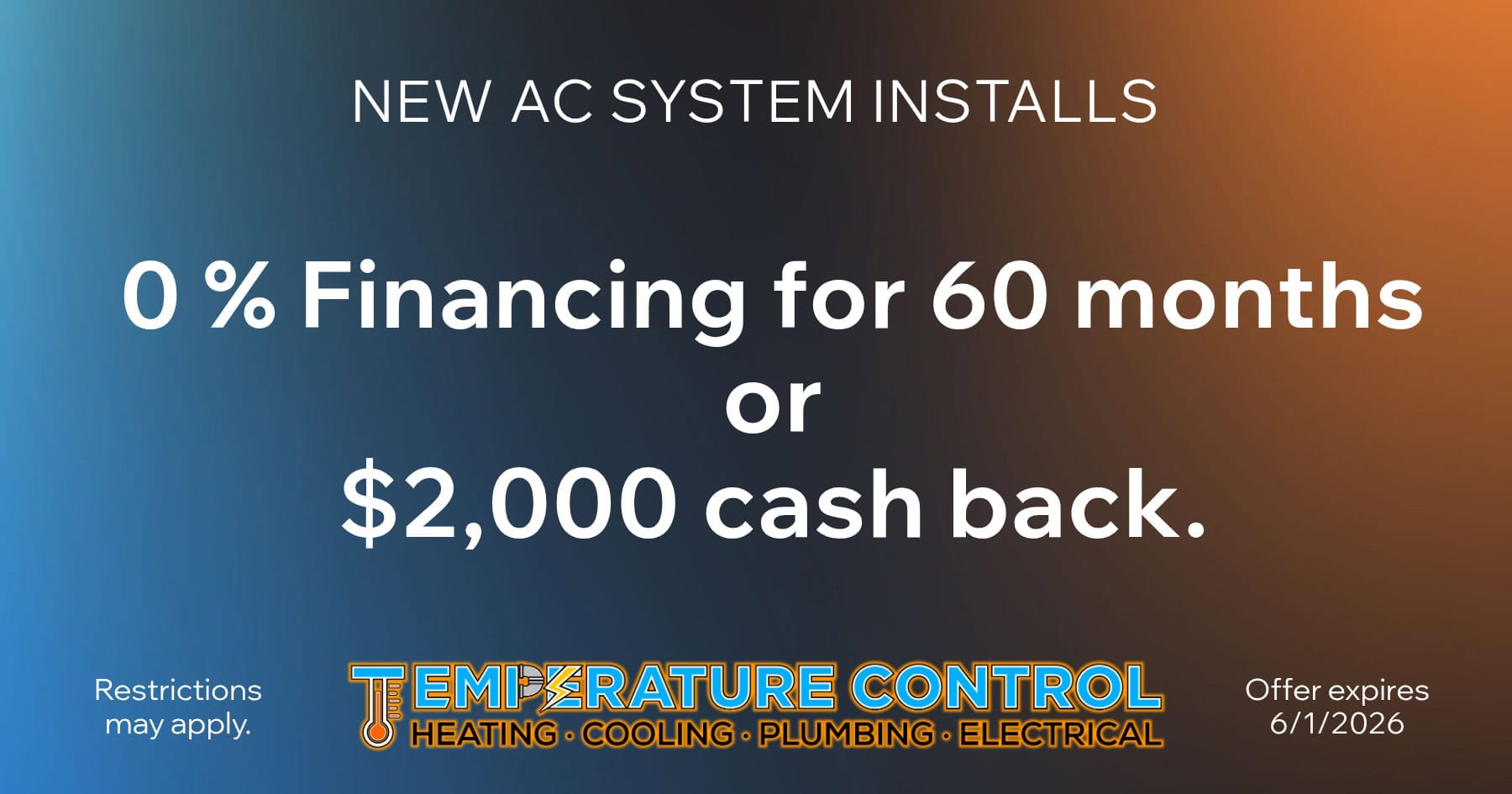
We also offer several financing options, with approved credit, to help if this is a concern. Contact us to discuss how our team can guide you through our process.
Air Conditioning Repairs
Not having your air conditioner working on the hottest of days in Arizona can be exasperating. Whenever you need an AC repair, let our heating and cooling experts quickly remedy it for you.
There are many ways your air conditioner can stop working in its normal capacity. A few symptoms you could experience are:
- Hearing an unusual noise
- Smelling an unusual odor like burning
- Feeling warm air coming from your vents
- Noticing your air conditioner is frozen
- Leaking water
These symptoms mean you have an issue with your air conditioner. Ignoring problems usually only makes them bigger and more costly. Our recommendation is to have one of our Temperature Control team members promptly diagnose and repair the issue for you.
Sometimes a repair turns into an emergency. Give us a call when it’s urgent. We are here 24/7 for you.
When you do need our professionals to make a repair, you can count on it staying repaired. We make our repairs right the first time—and only use the highest quality parts and materials when working on your system. Our experts are always here for you.
Air Conditioning Maintenance
Keeping your air conditioner in its best operating condition is your goal. You want your system inspected, cleaned, and tuned up on a regular basis to help avoid unexpected and costly repairs and breakdowns.
Routine air conditioning maintenance by our trained and experienced Temperature Control team helps your air conditioner cool your Tucson, AZ, home efficiently and reliably. With annual professional care, you may experience maintenance benefits such as improved energy efficiency, extended system life span, and decreased emergencies.
We recommend having our experts prep your air conditioner before you use it for the first time in the spring to give you consistent cooling all season.
To help you manage your maintenance, talk to us about our maintenance program, Safety and Efficiency Agreement. Your air conditioner tune-up and inspection are part of the plan, so call and speak with one of our educated and friendly team members about our program today.
Trust Temperature Control With All Your Air Conditioning Needs
We provide all the services you need to achieve the level of cooling comfort you want in your Tucson, AZ, home from your air conditioner. Call Temperature Control at (520) 815-5665 or request service online today to schedule your air conditioning installation, replacement, repair, or maintenance.