
How to Adjust Your Water Heater Settings for Arizona’s Winters and Summers
We’re no strangers to temperature extremes in Tucson. We go from 110-degree summer afternoons to freezing winter nights, while tweaking thermostat settings along the way.
While you’re hands-on with your thermostat, keeping your home comfortable and your HVAC efficient, you may have forgotten about another hardworking appliance that benefits from adjustment: your water heater.
At Temperature Control, we regard your water heater as the unsung hero of your home. It’s responsible for approximately eight percent of your total energy use, and in Arizona’s climate, its efficiency depends heavily on how it’s tuned for the seasons.
Learn why adjusting your settings—and keeping up with maintenance—is the secret to lower bills and better showers year-round.
How Seasonal Settings Save Money on Tucson Energy Bills
Water heater efficiency depends on something called the delta, which is he difference between the temperature of the water entering your Oro Valley home and the temperature you want at the faucet.
In our desert summers, the ground is so hot that the water entering your pipes might already be 80°F or higher. Your heater only has to do a little bit of work to reach its goal. In the winter, however, the groundwater temperature can plummet to 55°F or 60°F. Suddenly, your heater has to work twice as hard to deliver the same hot shower.
By adjusting your settings, you can bridge the gap.
Summer Setting: Keep your setting locked in at 120°F. Since the incoming water is already warm, you’ll save a bundle on energy.
Winter Setting: Although 120°F is still the best setting for safety, you might find you need a slight nudge to 125°F to compensate for heat loss in the cold pipes running through your attic or crawlspace.
Where to Find Your Water Heater Settings
Most tank-style gas water heaters have a dial located near the bottom of the tank. If your water heater is electric, look for a small panel on the side of the tank. The dials usually range from 90°F to 140°F, or use a scale like “low/vacation” to “very hot.”
The DOE recommends setting your water heater to 120°F. This is the 'sweet spot' for most homes: it's hot enough to stunt the growth of bacteria like Legionella while being cool enough to prevent accidental scalding.
It’s also the most energy-efficient setting for the average family in Pima County. However, if you have high-risk individuals in your home, ask us about installing a mixing valve—this allows you to keep your tank at a bacteria-killing 140°F while delivering a safe 120°F to your taps.
Protect Your Water Heater from Tucson’s Hard Water Scale
You’ve likely noticed the white, crusty buildup on your showerhead or faucets. That is calcium and magnesium, the primary minerals that make water in Marana hard.
Here is a bit of science that many homeowners don't realize: heat significantly accelerates mineral scaling. The hotter you set your water heater, the faster those minerals settle to the bottom of your tank or accumulate inside your heating elements, forming a layer of rock between the water and the burner.
If your heater is set too high in the summer, you are actively shortening its life by allowing minerals to cook onto the components. Keeping your temperature at 120°F or lower is one of the best ways to protect your heater from mineral buildup.
Should You Adjust Temps on a Tankless Heater?
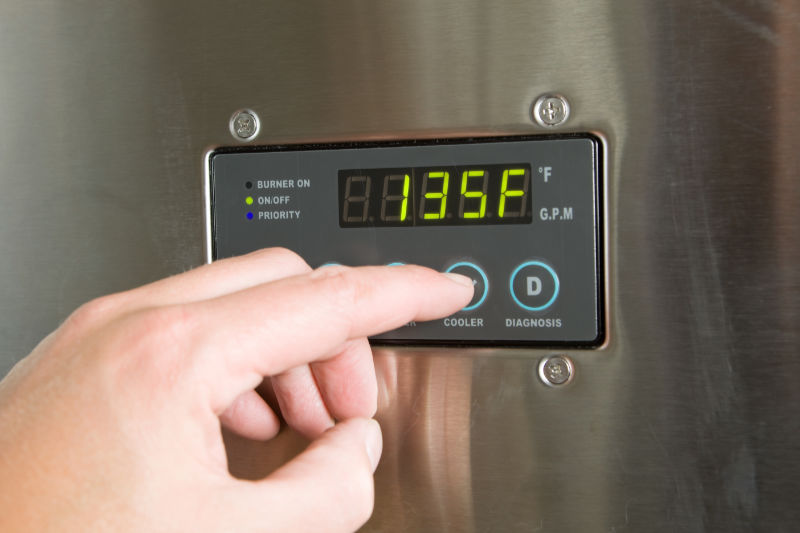
If you’ve upgraded to a tankless water heater, you might assume seasonal adjustments aren’t necessary. Even though tankless units are incredibly efficient, they are actually more sensitive to groundwater temperatures.
In the winter, a tankless unit might need to slow the water flow to ensure it has enough time to heat 55°F water up to 120°F. By adjusting the temperature on your tankless heater’s digital display, you can maintain a consistent flow rate.
Hard water scale in Tucson is a significant problem for the narrow heat exchangers inside tankless units, making seasonal temperature checks even more critical.
Water Heater Tune-Ups Are Crucial
Adjusting the dial is a great first step, but it’s only half the battle. To truly maximize efficiency and ensure your heater lasts 10-15 years, professional maintenance is essential.
During a typical maintenance visit, our Temperature Control technicians perform several key tasks:
The Tank Flush: We drain and flush the tank to remove sediment buildup. This stops the popping and rumbling sounds you might hear and allows the burner to heat the water directly.
Anode Rod Inspection: This rod is designed to rust, so your tank doesn't. In hard water areas, these rods can vanish in just a few years. We check it and replace it if necessary to prevent tank leaks.
Safety Check: We test the temperature and pressure relief valve to ensure the unit won't over-pressurize.
Adjust Your Water Heater for Better Efficiency
Need advice on water heater settings in Marana? Let Temperature Control show you how to improve your water heater’s efficiency with seasonal setting adjustments. Schedule a tune-up and a sediment flush to improve efficiency and extend your heater’s lifespan. Call us at 520-815-5665 or request service online.